Walk into any nail salon and ask, “What lasts longer: BIAB or Shellac?” and you’ll usually get a slightly complicated answer followed by the kind of smile that says, well, that depends. Which is fair enough. Nails are not one-size-fits-all, no matter how much we pretend otherwise while scrolling through immaculate manicures on a Thursday night.
If you’re trying to choose between BIAB and Shellac, the short version is this: BIAB usually lasts longer. But there’s a lot more to it than a simple winner’s podium. The real answer depends on your natural nails, your daily habits, and whether you treat your hands like delicate antiques or like tools for opening delivery boxes and scraping sticker labels off glass jars.
Let’s break it down properly, without the salon jargon fog.
What is BIAB, exactly?
BIAB stands for Builder In A Bottle. It’s a soak-off gel formula designed to strengthen the natural nail while adding a bit of structure. Think of it as a supportive layer: not as rigid as acrylic, not as thin as standard gel polish, and definitely not the same beast as your average colour coat.
BIAB is often used to:
In plain English: BIAB is the manicure equivalent of a decent pair of walking shoes. It’s there to support you, not just look pretty for the first few steps.
And Shellac, what’s the deal there?
Shellac is a hybrid nail product, usually referring to CND Shellac, which combines the ease of polish with the durability of gel. It’s thinner than BIAB, cures under a lamp, and gives that glossy, chip-resistant finish people love when they want neat nails without the fuss.
Shellac is popular because it’s:
If BIAB is the sturdy little umbrella that keeps your nails dry in a storm, Shellac is the slick raincoat: practical, polished, and elegant, but not built to withstand a full-blown monsoon.
Which one lasts longer?
Here’s the headline answer: BIAB usually lasts longer than Shellac.
On average, Shellac lasts around 2 to 3 weeks before it may start to show wear, especially at the tips or near the cuticle. BIAB often lasts 3 to 4 weeks, and sometimes longer if the application is good and your nails aren’t under constant assault from typing, gardening, cleaning, or whatever life throws at your fingertips.
But “lasts longer” can mean different things. Does it mean:
Because Shellac can stay looking neat for a decent stretch, but BIAB tends to hold its structure better over time. It’s more resistant to breakage and lifting, especially on nails that are weak, soft, or prone to bending.
Why BIAB tends to win on durability
The difference comes down to thickness and strength. BIAB creates a stronger overlay on the nail, which makes it better suited to protecting natural nails against daily wear and tear.
That extra structure matters if your nails:
Shellac, on the other hand, sits more like a colour coating. It’s excellent for finish and shine, but it doesn’t add much reinforcement. So if your nails are already strong, Shellac can look great and last well enough. If your nails are a bit fragile, Shellac may start showing damage sooner than BIAB.
That said, durability isn’t just about the product. A sloppy application can sabotage even the best formula. A flawless BIAB manicure done badly won’t magically outperform a well-applied Shellac set. Nails, like most things in life, appreciate competence.
How your lifestyle affects manicure lifespan
Not every manicure lives the same life. Some are pampered. Others are out there fighting for their lives against dishwashing, commuting, gym sessions, and the occasional panic-yank of a stubborn zip.
If your daily routine includes a lot of hand use, BIAB is usually the safer bet. It tends to handle stress better because it has more body and support. Shellac can still be a great option, but it may chip more quickly if you’re rough on your hands.
You may want BIAB if you:
You may prefer Shellac if you:
So the “best” option depends on whether you need a bodyguard or just a nice-looking outfit.
What about nail health?
This is where people get a little precious, and honestly, fair enough. Nobody wants beautiful nails now and damaged nails later. The good news is that both BIAB and Shellac can be used safely when applied and removed properly.
BIAB gets praised for helping strengthen nails over time, especially when it’s used as a protective layer while your natural nails recover. Shellac is also relatively gentle compared with more aggressive systems, but because it’s thinner, it offers less physical protection.
One important caveat: the removal process matters just as much as the manicure itself. Picking, peeling, or ripping off either BIAB or Shellac is a fast track to sad, flaky nails and regret. If you’re the sort of person who peels off gel while watching TV, this is your gentle reminder to stop treating your nail bed like a scratch card.
Proper removal should involve:
Damage is usually caused less by the product itself and more by how impatient we all become the moment a nail starts lifting.
Which looks better for longer?
Ah yes, the glamour question. Because lasting longer on paper is one thing, but lasting longer while still looking decent is what actually matters when you’re staring at your hands every five minutes.
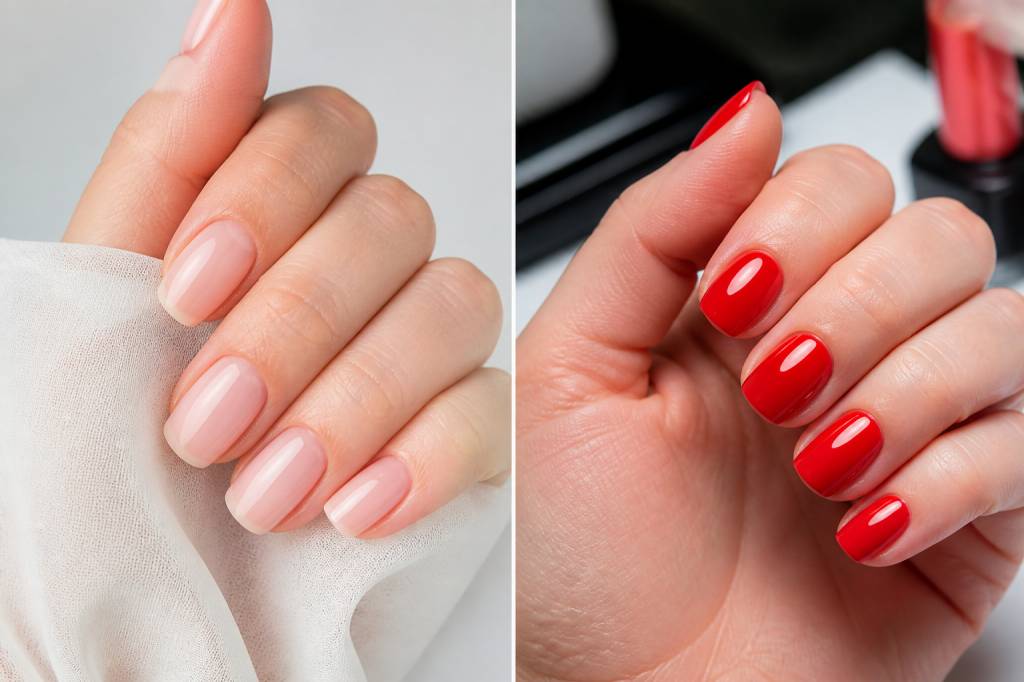
Shellac gives a sleek, glossy, polished finish. It’s excellent for a clean, natural look, and it tends to stay shiny for a good while. BIAB, meanwhile, can look slightly more “done” because it adds structure and often a bit more thickness. If you’re wearing it nude or sheer, it can still look beautifully natural, but it’s usually a touch more substantial.
In terms of visible wear, BIAB often stays looking tidier longer because it resists chips, cracks, and breakage better. Shellac may keep its shine, but if the tips are worn or there’s lifting near the cuticle, it can start looking tired sooner.
So if your priority is “I want my nails to look fresh for as long as humanly possible,” BIAB probably has the edge.
Can Shellac be a better choice sometimes?
Absolutely. Not every manicure needs to go ten rounds with daily life. Shellac can be the better option if you want something lighter, cheaper, or quicker to apply. It’s also a good fit if you don’t need much reinforcement and just want a neat, glossy finish for a couple of weeks.
Shellac is often a smart pick for:
BIAB can feel like overkill if your nails are already strong and you just want a clean colour coat. Why bring a crate of tools to hang a picture frame, after all?
Can BIAB and Shellac be combined?
Yes, and this is where many nail techs quietly nod with approval. A common approach is to use BIAB as the base layer for strength, then add Shellac colour on top for the finish. That gives you the best of both worlds: durability from BIAB and the colour flexibility of Shellac.
This combo works especially well if you want:
It’s a bit like having a reliable car with a fancy paint job. Practical and attractive. What a concept.
How to make either manicure last longer
If you want your manicure to go the distance, a few habits make a huge difference. No product can fully survive hands that are constantly being used as opening tools, scrapers, and emergency screwdrivers.
To help BIAB or Shellac last longer:
One of the biggest manicure killers is water exposure combined with mechanical stress. If your hands live in sinks, your nails will not be thrilled. Simple as that.
So which one should you choose?
If your main question is longevity, BIAB is the better choice. It generally lasts longer, offers more strength, and is better for weak or damaged nails. If you want a manicure that can survive real life with a bit more dignity, BIAB is likely the better investment.
Shellac still has its place. It’s great for a lighter, glossier, quicker manicure and works well on naturally strong nails. It may not last as long as BIAB, but for many people, it’s more than enough.
Here’s the simplest way to think about it:
In the end, the longer-lasting manicure is usually the one that matches your nails and your lifestyle. Because the best manicure isn’t just the one that survives the week — it’s the one that still looks good after you’ve lived your life with it.